Eskayef Logo Eskayef Logo
  • Home
  • About
    • Executive Committee
      • Present EC Members
      • Honorable President & GS
      • Past EC Members
    • History of AOBA
    • Academic Programs
    • Activities of AOBA
    • Proposed University
    • Sir Syed The Peace Maker
  • Notice & Events
    • Notices
    • Events
  • Gallery
  • Archive
  • Contact

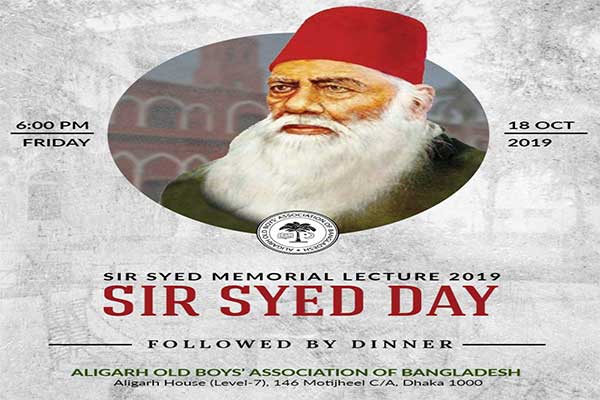
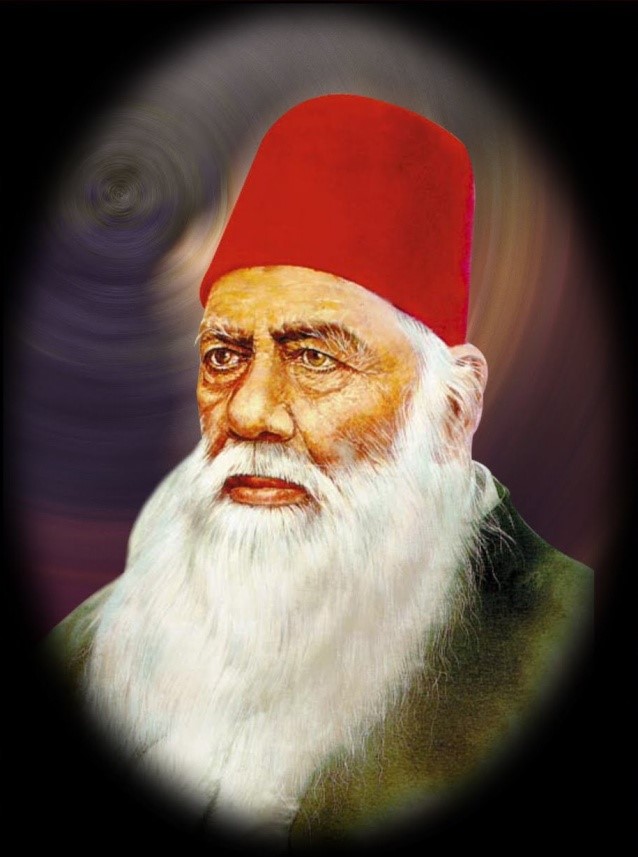
Sir Syed Ahmed Khan

John Doe

Founder

October 17, 1817 – March 27, 1898
Aligarh Muslim University, India

Sir Syed Ahmad Khan, one of the architects of modern India was an Anglophile Indian Muslim pragmatist, Islamic modernist, philosopher and social activist of nineteenth century India. In 1875, Syed Ahmad Khan established the Muhammadan Anglo-Oriental College at Aligarh and expressed the hope “that this college may expand into a university whose sons shall go forth throughout the length and breadth of the land to preach the gospel of free enquiry, of large hearted toleration and of pure morality.” Twenty two years after his deaths, his dream was realized and the M.A.O. College developed into the Aligarh Muslim University.“ Today, the university is ranks among the top universities in India.

SIR SYED THE PEACE MAKER

John Doe

Prof. Dr. Mohammad Ibrahim


Ex-President (01 March 2016-2018) , Aligarh Old Boys’ Association of Bangladesh

Professor, Department of Islamic History & Culture, Dhaka University.
Also Chairman, Department of Islamic History & Culture D.U. (2002-2005)

M.Phil.in History, Faculty of Social Science (1982-1984),
Ph.D.in History, Faculty of Social Science (1984-1986),
Arabic & Persian Languages (1982-1983), Deptt. Of Persian,
Arabic Language (1984-1984) Centre for West Asian Studies, AMU

Syed Ahmad Khan (1817-1898 AC) is a legendary leader in his own capacity. The nineteenth century politics of India is a sad tale in which the Muslim subjects of the British Raj almost reached the brink of their fall from the height of a ruling race to the depth of a fallen community. Hardly had a century of the English East India Company’s rule passed when came the stiff phase of resistance in the form of the so-called Sepoy Mutiny among so many other movements. It was in reality the first phase of the war of Indian Independence from the yoke of English domination. The sure success of the English subjugation of India was effected by following a consistent policy of ‘divide and rule’ applied towards the two dominant communities of colonial India –viz. the Muslims and the Hindus. The liberal policy of the Muslim rulers of India starting right from Sultan Qutbuddin Aibek of Delhi 1206-1210 AC. down to Badshah Bahadur Shah Zafar (1858) which had brought about an effective reconciliation between the two major communities, was thrown to the winds by the astute and mischievous administrative policy of the alien English rulers who were out to see it that their domination over the subject peoples perpetuate to their great relief. Thus started the long-drawn sad tale of the Indian Muslims. However, it was in the mass eruption of the deep indignation of the teeming millions of India that culminated in the ‘Revolt of 1857,’ which both the communities shared enthusiastically. However, History holds it on record that instead of solving their problems to the slightest degree, this revolt cast the Muslims from the frying pan to the blazing fire. By pursuing an unjust policy of discrimination the Hindu community was patronized by the ruling masters at the cost of the interest of the Muslims community whom the British Raj identified as the only party at fault. A policy of severe repression was unremittingly followed against the Muslims. They were branded as traitors guilty of sedition and treason. A conscious policy mass scale persecution was about to strangulate the Muslim community to its utter surprise. The situation had come to such a sorry pass that it clearly heard its death-sentence being pronounced by their masters. When the tension between the Raj and the Muslim community assumed its furthest limit, a beam of light appeared on the horizon in the person of Jonab Syed Ahmad Khan –then in the service of the Anglo-Indian Government. Pertinently it should be mentioned here that Syed Ahmad Khan had started his career in the Law department of the Company in 1839. later he rose to the position of a Munsif in 1841 and made his mark as an efficient judge to have been transferred to Moradabad by 1858 when India was brought under the British imperial canopy.
history
history
history

Overwhelmed and over –awed at the British attrocities upon the Muslim community Syed Ahmad hastened to the rescue of his fellow co-religionists. This time his weapon was his forceful pen. The very following year (1859) saw the publication of his brochure entitled ‘ASBAB-I-BAGHAWAT-I-HIND’ meaning the ‘CAUSES OF THE INDIAN REVOLT’ in which he brought to sharp focus the objective situation culminating in the uprisings of 1857. It amply proved that the Muslim Community was wrongly and unjustifiably blamed for it. Hence it did not quite deserve the discriminatory policy of wanton persecution. His argument was that the Muslims too were adequately loyal subjects of the British Raj. Syed Ahmad’s discreet stand largely assuaged the rage of the rulers who thenceforth substituted their ‘fire and iron policy’ against the Muslims by exchanging it with the policy of reconciliation and appeasement. In the following year (1860) Syed Ahmad Khan supplemented his first brochure by publishing a similar one under the title the ‘Loyal Muhammadans of India.’ This embodied Fatwas (Legal or juristic opinion of the liberal clerics of Islam- the Ulama-to the purport that in spite of her being under Kafir (infidel or Christian) rule. India was a ‘Daarul Islam’ (the Abode of Islam) as against the conservative stand that India under British domination was a ‘Daarul Harb’ (the Enemy Territory). Then followed Syed Ahmad Khan’s additional intellectual initiatives in the form of founding the Scientific Society, publication of the Aligarh Institute Gazette, formation of the British India Association’—all in 1866, the research periodical ‘Tahzibul Akhlaq’ (1870), Muhammadan Anglo-Oriental College (1875), his collected works, Vol.1. (1883), founding the Aligarh Educational Conference (1886), the Indian Patriotic Association (1888) etc. While on a visit to London in 1869 he was conferred the C.S.I. title and later in 1878 he was appointed a member of the Viceroy’s Council. Syed Ahmad Khan the unqualified and discreet admirer of the British rule was knighted with the much-coveted title of K.C.S.I. in 1888 exactly ten years before his final exit to the abode of eternal rest in 1898. His anti-Congress stand and his anti-Taqlid (non-traditional) views on Islam placed him in the teeth of lethal opposition from both the Hindu and the Muslim camps. However, this ambassador of peace counted a host of admirers and followers who later served as the torch-bearers of his pragmatic and liberal mission—the intellectual elevation of his own community in the most hostile environment ever to be conceived.

Sources:

  • Wilfred Cantwell Smith : Modern Islam in India, 2nd Rvd. Edn., Lahore, 1947.
  • Sir Syed Ahmad Khan –the First Death Centenary Commemoration, Volume NRSC, The glowing legend of Sir Syed 1998, Editor-Ziaur Rahman NRSC., Aligarh 1998.
Aligarh Old Boys' Association of Bangladesh
Powered By: Psionic Interactive Limited